← Projects
Eapy
2024–2025 · Pozalabs · Product Manager
A workspace where musicians keep ideas, references and AI-generated MIDI on one infinite canvas, plus Slide, a press kit shared as a single link. I helped lead it from ideation to 40,000 users in under six months.Eapy was built in Pozalabs, an ethical AI music lab based in Seoul.
An Eapy canvas demo: drag in a sketch, write lyrics, upload samples/demos, pin references and notes, then share it as a link.
Details
Role
Product Manager II: product, design, growth and marketing
Team
8, growing as more of the company joined
When
May 2024 – May 2025 · launched December 2024
Stack
Python, FastAPI, MongoDB, AWS
Background
Background
After a few months of interning in R&D and BD, I offered to lead a new consumer product team to help Pozalabs’ expansion into global markets and moved to Seoul. We tested consumer uses for AI music and quickly landed on our strongest insight: Pozalabs, unlike competitors rooted in diffusion models, could generate each part of a song as its own stem with our combinatorial generation process, but the generated tracks were not yet at professional release quality without mixing. Professional musicians overwhelmingly used our models for stem generation on our Discord, and wanted a way to view and iterate upon dozens of samples at the same time, leading to our first product, Canvas. A few hundred interviews and tests later, a second use case appeared: musicians were turning their boards into portfolios to send to labels and their fans, which led to our second product, Slide.
Canvas
Canvas was Eapy’s first product, and let musicians create canvases to ideate and share their music creation process collaboratively. Most professional songwriting now happens asynchronously without comprehensive documentation, and Eapy allowed musicians to jam on writing lyrics, sharing samples and references, and generate new MIDI samples using existing references or natural language prompts. During our development, we discovered an additional use case of artists using Eapy to share their process with their fans and labels.
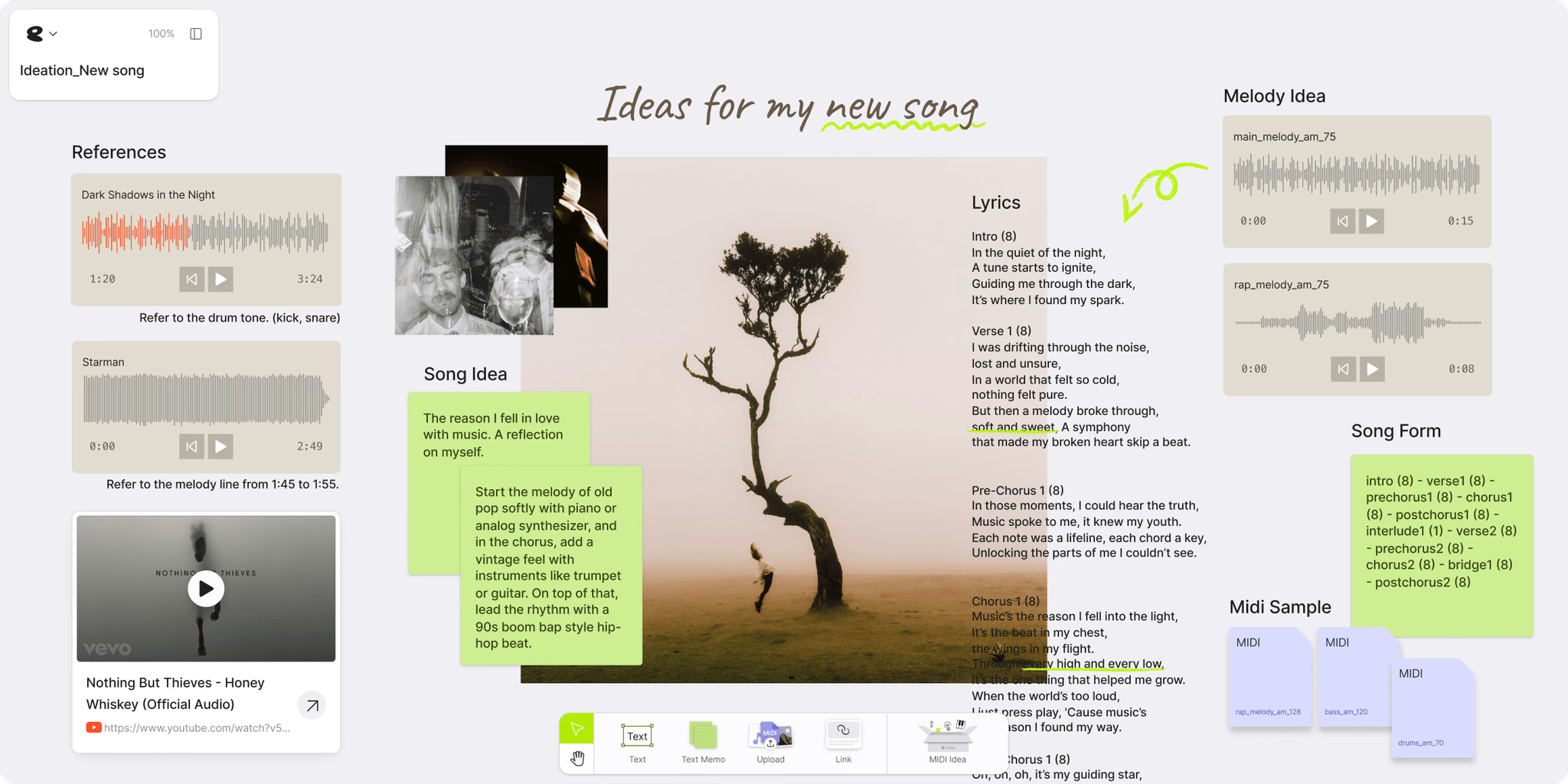
Workflow use case
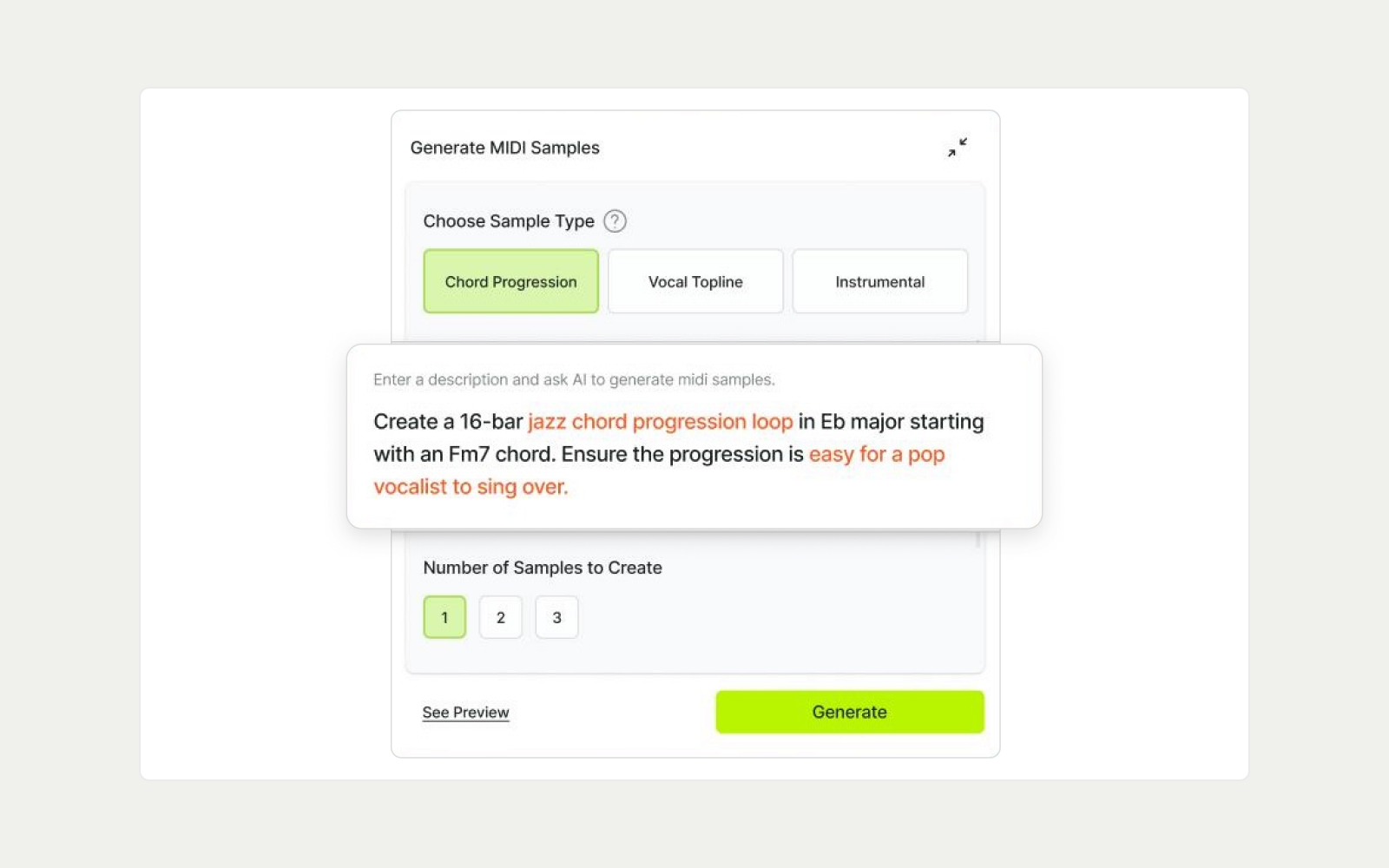
Generating MIDI from a text prompt, right on the board.
Slide
To help indie artists pitch themselves to labels, we made an electronic press kit (EPK) artists build by uploading music, images and text. A&Rs, labels and sync agents open one link to see and hear everything, instead of a zip file.
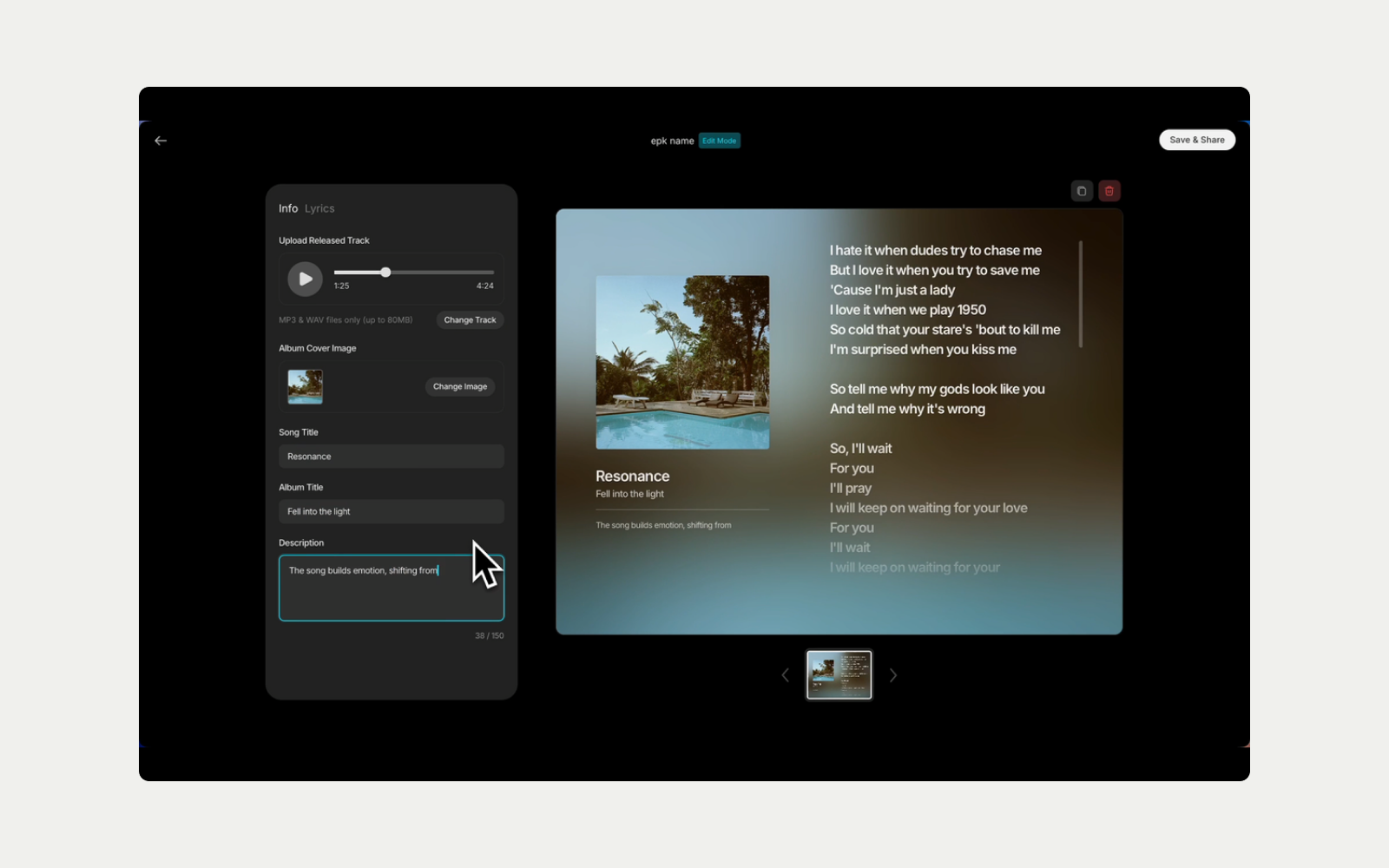
A Slide press kit: an artist’s music, images and text on one page.
What I did
Led product, design, growth and marketing from zero to launch, with a team of 8 that grew month over month.
Outcome
40,000 users in under six months. #4 Product of the Day on Product Hunt (233 upvotes). Promoted twice in under a year. Eapy’s traction gave the team visibility in the US, which helped lead to the Eclipsa Audio partnership at CES 2025.
Next
Woodshed →
← Projects
Eapy
2024–2025 · Pozalabs · Product Manager
A workspace where musicians keep ideas, references and AI-generated MIDI on one infinite canvas, plus Slide, a press kit shared as a single link. I helped lead it from ideation to 40,000 users in under six months.Eapy was built in Pozalabs, an ethical AI music lab based in Seoul.
An Eapy canvas demo: drag in a sketch, write lyrics, upload samples/demos, pin references and notes, then share it as a link.
Details
Role
Product Manager II: product, design, growth and marketing
Team
8, growing as more of the company joined
When
May 2024 – May 2025 · launched December 2024
Stack
Python, FastAPI, MongoDB, AWS
Background
Background
After a few months of interning in R&D and BD, I offered to lead a new consumer product team to help Pozalabs’ expansion into global markets and moved to Seoul. We tested consumer uses for AI music and quickly landed on our strongest insight: Pozalabs, unlike competitors rooted in diffusion models, could generate each part of a song as its own stem with our combinatorial generation process, but the generated tracks were not yet at professional release quality without mixing. Professional musicians overwhelmingly used our models for stem generation on our Discord, and wanted a way to view and iterate upon dozens of samples at the same time, leading to our first product, Canvas. A few hundred interviews and tests later, a second use case appeared: musicians were turning their boards into portfolios to send to labels and their fans, which led to our second product, Slide.
Canvas
Canvas was Eapy’s first product, and let musicians create canvases to ideate and share their music creation process collaboratively. Most professional songwriting now happens asynchronously without comprehensive documentation, and Eapy allowed musicians to jam on writing lyrics, sharing samples and references, and generate new MIDI samples using existing references or natural language prompts. During our development, we discovered an additional use case of artists using Eapy to share their process with their fans and labels.
Workflow use case
Generating MIDI from a text prompt, right on the board.
Slide
To help indie artists pitch themselves to labels, we made an electronic press kit (EPK) artists build by uploading music, images and text. A&Rs, labels and sync agents open one link to see and hear everything, instead of a zip file.
A Slide press kit: an artist’s music, images and text on one page.
What I did
Led product, design, growth and marketing from zero to launch, with a team of 8 that grew month over month.
Outcome
40,000 users in under six months. #4 Product of the Day on Product Hunt (233 upvotes). Promoted twice in under a year. Eapy’s traction gave the team visibility in the US, which helped lead to the Eclipsa Audio partnership at CES 2025.
Next
Woodshed →